
Stories from the Street
How many paths are there to Heaven?
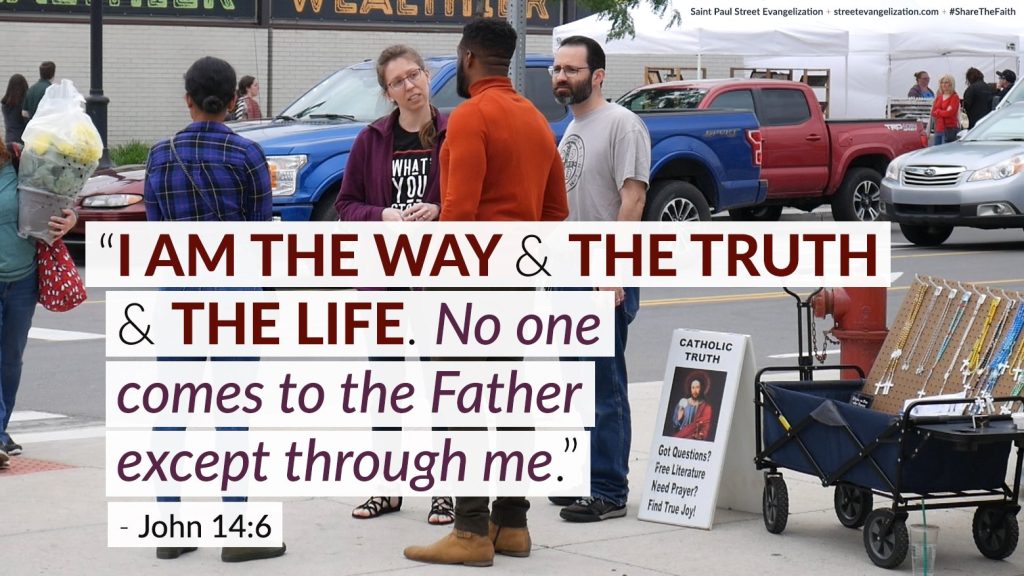
Detroit, Michigan. In our pluralistic society, many people falsely believe that “almost everybody will go to heaven,” regardless of their faith or merit. While we do not focus on apologetics and we do not condemn anyone, we do believe in paragraph 183 of the Catechism of the Catholic Church: “Faith is necessary for salvation. The Lord himself affirms: ‘He who believes and is baptized will be saved; but he who does not believe will be condemned.’ (Mark 16:16).”
In our pluralistic society, many people falsely believe that “almost everybody will go to heaven,” regardless of their faith or merit. While we do not focus on apologetics and we do not condemn anyone, we do believe in paragraph 183 of the Catechism of the Catholic Church: “Faith is necessary for salvation. The Lord himself affirms: ‘He who believes and is baptized will be saved; but he who does not believe will be condemned.’ (Mark 16:16).”
This report comes from evangelist Mark in Detroit, MI:
A team of four evangelized at Eastern Market on a cool Saturday morning. I had a long and fruitful conversation with Manuel, a thirty-something man who grew up in Africa. He was a practicing Catholic in his youth and even discerned in seminary but has since fallen away from the practice of the Faith. Manuel still identifies as a Catholic but had a few misconceptions, mainly about salvation and about the impact of Christianity upon the world. He kept talking about “all of the bad things that Christianity has done.”
He asked me “how many paths are there to heaven?” Manuel was angry at Christians who say that faith in Jesus is necessary for salvation. I told him that Jesus is the only way to salvation, referring to John 14:6—“I am the way and the truth and the life. No one comes to the Father except through me.” But I also told him that when Pope Benedict XVI, in an interview, was asked “how many paths there are to heaven?”, he answered, “As many as there are people.” The former Pope understood that every person is called to salvation through Jesus, and every person will be given ample chance to find it. I told him that God judges each person justly based on their deeds, and he doesn’t condemn anyone for what they do not know.
Then Manuel said he was angry even at that. He asked how I could suggest that a person who hears me preach about Jesus could be in danger of losing his soul because he ignored me? I answered him by saying, “And I, too, might lose my soul because I don’t always live up to God’s calling. We’re all subject to the judgment and the mercy of God; people out of the Church and people in the Church.” That seemed to appease him on that point, at least for the time being.
Then Manuel moved on, saying that “Christianity has done more bad than good,” and gave a few specific examples. I affirmed that many Christians have done great evils, but kept reminding him of the great good also done by Christians. Eventually, I brought up that Jesus had one among the 12 Apostles who was wicked and then reminded him about Matthew 13:24-30, the parable of the weeds among the wheat. I said that bad Christians are like weeds but good Christians are like wheat. God does not wish to pull up the weeds yet, lest he damage the wheat at the same time. That seemed to make a lot of sense to him. As he was getting ready to leave, I recommended that he read a book called “Atheist Delusions,” on how Christianity changed the world for the better. He said he would look it up. I don’t know what will come of our conversation, but I know that I told him some things that he hadn’t thought of. I now pray for him sometimes.
More Stories from the Street
 Story
StoryOne Good Conversation is All You Need
Eric, Michael, and I returned to evangelize outside of Eastern Market last Saturday. The morning started with heavy rain—I thought about cancelling the outing but decided to keep my commitment. The rain…
Read the story → Story
StoryGod Save Our Culture, Pt. 2
A group of 6 or 7 older teens stopped at the word “free”. Between them, they claimed my entire week’s allotment of chain Rosaries (of which I had been planning to lay…
Read the story → Story
StoryLearning from our Mistakes
My friend Brandon and I tried our first outing this past Friday. Unfortunately, it was quite disastrous. For some reason, we got it in our heads that we didn't have to engage…
Read the story →